Trending

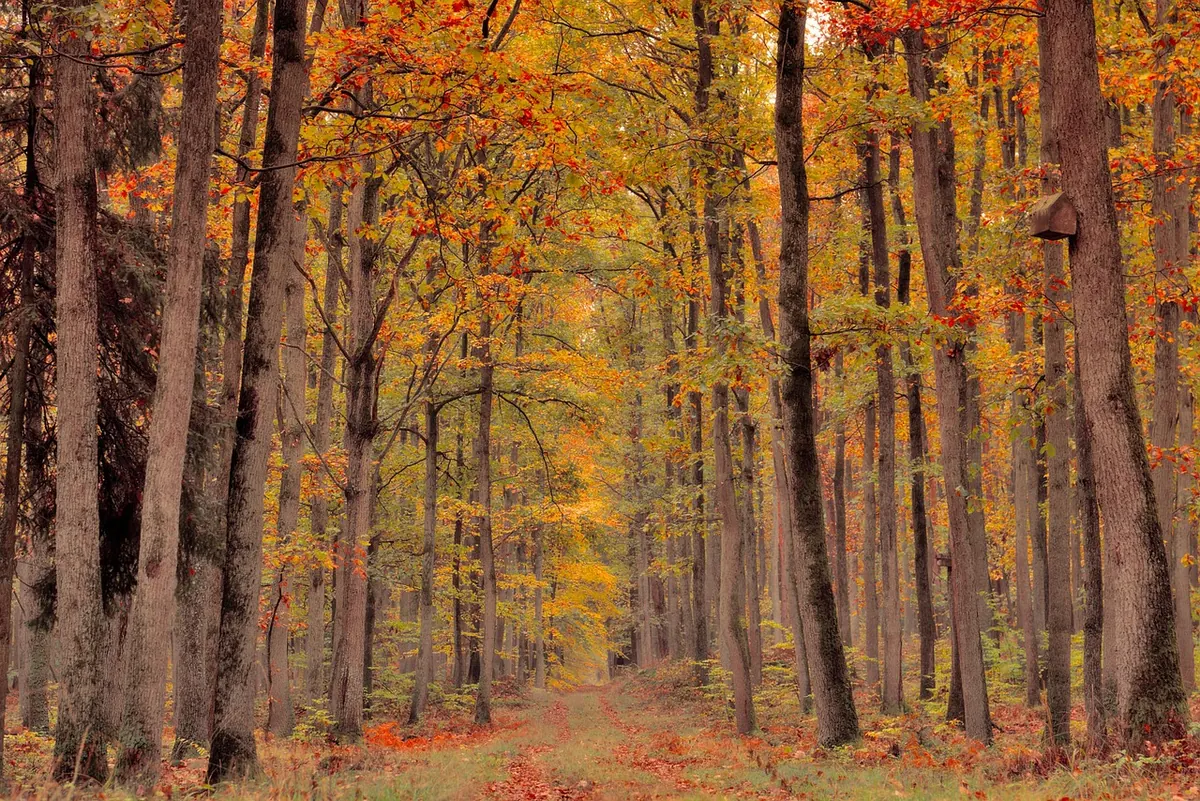
Larch is the conifer that breaks the rules. It carries needles and cones like a spruce, then turns gold in autumn and drops the lot, leaving a skeleton of orange-brown twigs that looks, at a distance, half dead. Pass one in July and you will barely notice it. Pass it in the second week of November and you will stop walking.
That transformation is the reason for this selection. Larch is planted in mixed forestry blocks rather than ancient woodland, so you seldom get a whole hillside of it — more often a scatter of gold threaded through dark pine, which arguably looks better. What follows is where to go, when to go, and what to look at once you are there.
Three larches do the work in Britain: European larch, Japanese larch, and their hybrid, Dunkeld larch, raised in Perthshire in the early twentieth century and now the most widely planted of the three. All behave the same way. Soft green needles shift through yellow to a deep amber, hold for a week or two, then drop.
That is also why the best larch walks tend to be in working forests — Forestry England and Forestry and Land Scotland holdings, forest parks, big estates with mixed conifer planting. Working forests have waymarked trails, decent car parks and open access, and larch usually sits on slopes and edges where the light is best.
Larch colour moves down the country in a fairly tight window, and altitude matters as much as latitude. A larch belt at 300 metres will turn seven to ten days before the same trees on a valley floor, and a south-facing edge will go before a shaded one.
Weather decides how long it lasts. A dry, still, cold autumn gives the longest display; two days of wind and heavy rain will strip a stand almost bare. So don't book a weekend months ahead and hope. Watch for the change and go within the week.
A few habits help:
And be prepared to walk past the first trees you meet. The car-park larch is a taster; the stand half a mile up the track, where gold meets dark spruce and the ground falls away, is the reason you came.
This is larch country in the strictest sense: the Dunkeld hybrid was raised here. The forests around Dunkeld and Birnam, the Queen Elizabeth Forest Park above Aberfoyle, and Faskally Wood near Pitlochry all mix larch with pine, birch and oak. The Trossachs gives you hillside views over gold, which is the version most people have in mind when they set out.
Grizedale and Whinlatter are both working forests with waymarked routes, and both hold good larch among oak, spruce and pine. Grizedale's sculpture trails give you something to look at between the trees; Whinlatter's higher tracks put you above the colour, looking down into it.
Kielder is enormous and mixed, so treat it as a day of exploring rather than a single view; the larch shows best along the forest drives and around the reservoir edges. Hamsterley in County Durham and the woods around Rothbury are smaller, easier to read, and often quieter.
Coed y Brenin in Snowdonia and the Gwydir Forest around Betws-y-Coed offer larch on steep ground with mountain light. Be aware that larch felling for disease has changed parts of the Welsh landscape in recent years, so check current maps rather than an old guidebook. In the Midlands, the Wyre Forest, Cannock Chase and the Forest of Dean all hold larch in mixed stands, usually within a short walk of a car park.
Further south, the Chilterns and the western edge of the Weald carry larch among beech and oak, and the pairing of gold larch with coppery beech is one of the best autumn combinations in the country. In Northern Ireland, Tollymore and Castlewellan in County Down mix larch with oak, beech and pine, and the Mourne foothills give the same hillside-and-water framing you get in Scotland. In every case, the larch is a thread rather than a blanket — you are looking for it, not standing in it.
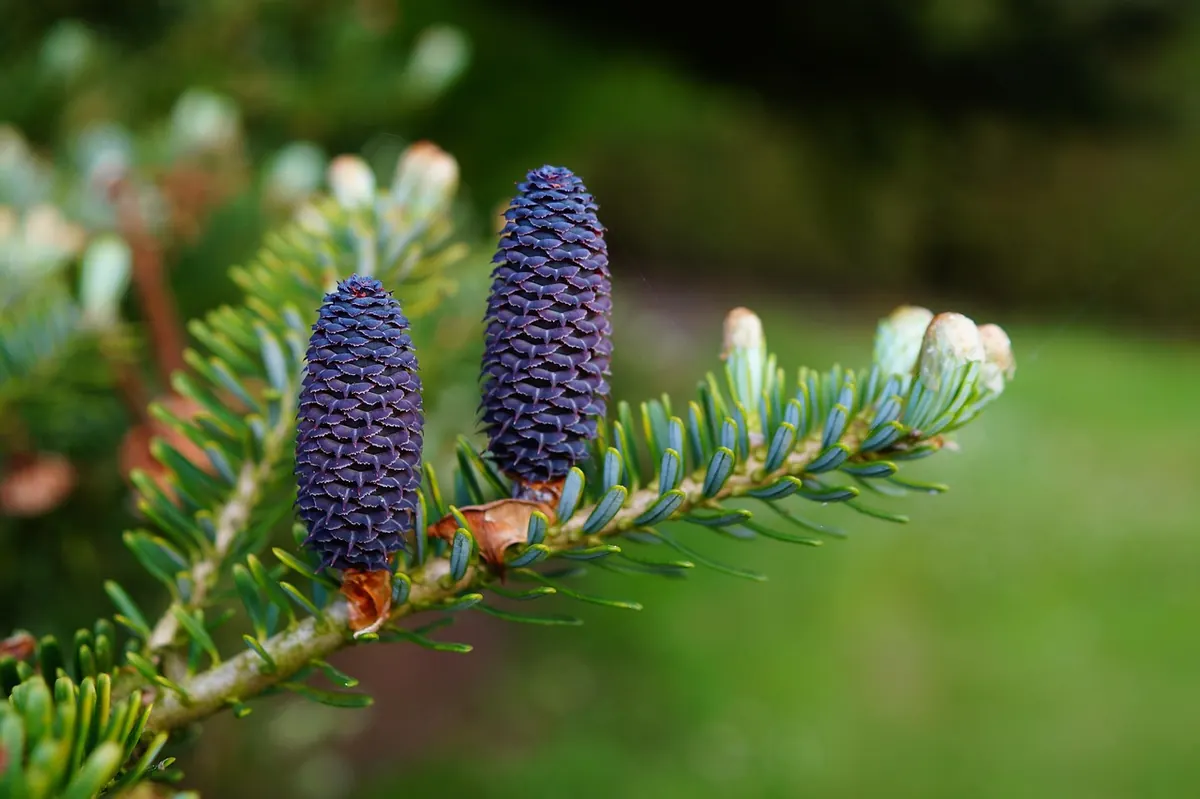
It is worth knowing which larch you are looking at, because the three are easy to tell apart once you know the trick. European larch has pale grey-pink shoots and small cones whose scales lie flat. Japanese larch has reddish shoots, longer and bluer needles, and cones with scales that curl back like tiny claws. Dunkeld larch sits between them — vigorous, variable, and often the tallest thing on the slope.
Look also at the needles themselves. They grow in tufts of twenty to forty on short woody spurs, which is what gives larch its soft, brush-like texture and its particular glow in low sun. And look at the branches: larch keeps its old cones for a year or more, so even a stripped November tree is dotted with small brown rosettes. It is never quite as empty as it first appears.
Since the mid-2000s, the pathogen Phytophthora ramorum has forced large-scale felling of larch, particularly Japanese larch, across south-west England, Wales, parts of Scotland and Ireland. The visible result is sudden clear-fell on slopes that were gold a few years ago, followed by replanting with broadleaves and other conifers. This is not a reason to stay away; it is a reason to check before you travel.
Forestry websites usually list closures, felling notices and replanting work, and local rangers are happy to point you towards stands still standing. Treat any guidebook more than a few years old as a rough sketch, and treat a favourite walk as something that may have changed. The larch will still be somewhere nearby; it just may not be where you left it.
Go for the colour, stay for the bare tree. A larch in December, all orange twigs and empty branches, is a more honest portrait of the species than any photograph of it in gold.
Photo: Peggychoucair / Pixabay