Trending

Someone points at a tree and says "that one's a larch". You have about ten seconds to look as though you know whether they are right. In late October the answer is easy, because the larch will be turning butter-yellow while everything around it stays green. For the other eleven months you need clues rather than luck. Happily, three of them — how the needles are fixed to the twig, where the cones sit, and what the tree does in winter — will get you there almost every time.
Larch is the only conifer you are likely to meet in a British woodland that sheds all its needles each year. In autumn they turn a warm gold, then fall, leaving a bare twig covered in small knobbly woody spurs. If you run a thumb along that twig in January, it feels like a rough, pebbled stem rather than a smooth one, and those little spurs are where next spring's needles will push out.
Pine, spruce and fir keep their needles for several years, so a bare, needle-free conifer in winter is almost certainly a larch. Just make sure the tree is genuinely bare rather than dead: a larch in January still has flexible, living twigs and tightly closed buds, and the spurs are crisp and woody rather than shrivelled.
This is where larch gives itself away fastest. Its needles are soft, flat and pale green, and they grow in tufts rather than singly along the twig. Each tuft sits on a short woody peg and holds twenty to forty needles. On brand-new shoots the needles appear singly, which trips people up in spring — look further back along the same branch and the tufts will be there.
Pine: needles come in bundles of two, three or five, bound together at the base by a thin papery sheath. Roll a bundle between your fingers and the sheath is obvious. Scots pine has two needles per bundle; most of the commonly planted pines in Britain have two or three.
Spruce: single needles all the way round the twig, each sitting on a small woody peg that stays behind when the needle drops. The needles are four-sided, so they will not flatten between finger and thumb, and the twig feels like a rough file. Pull one off and a stub remains.
Fir: single, flat, soft needles with no peg at all. Pull one away and you get a neat round scar on a smooth twig. Many firs have needles twisted at the base so they lie in two flat rows like a comb, often with two pale bands underneath.
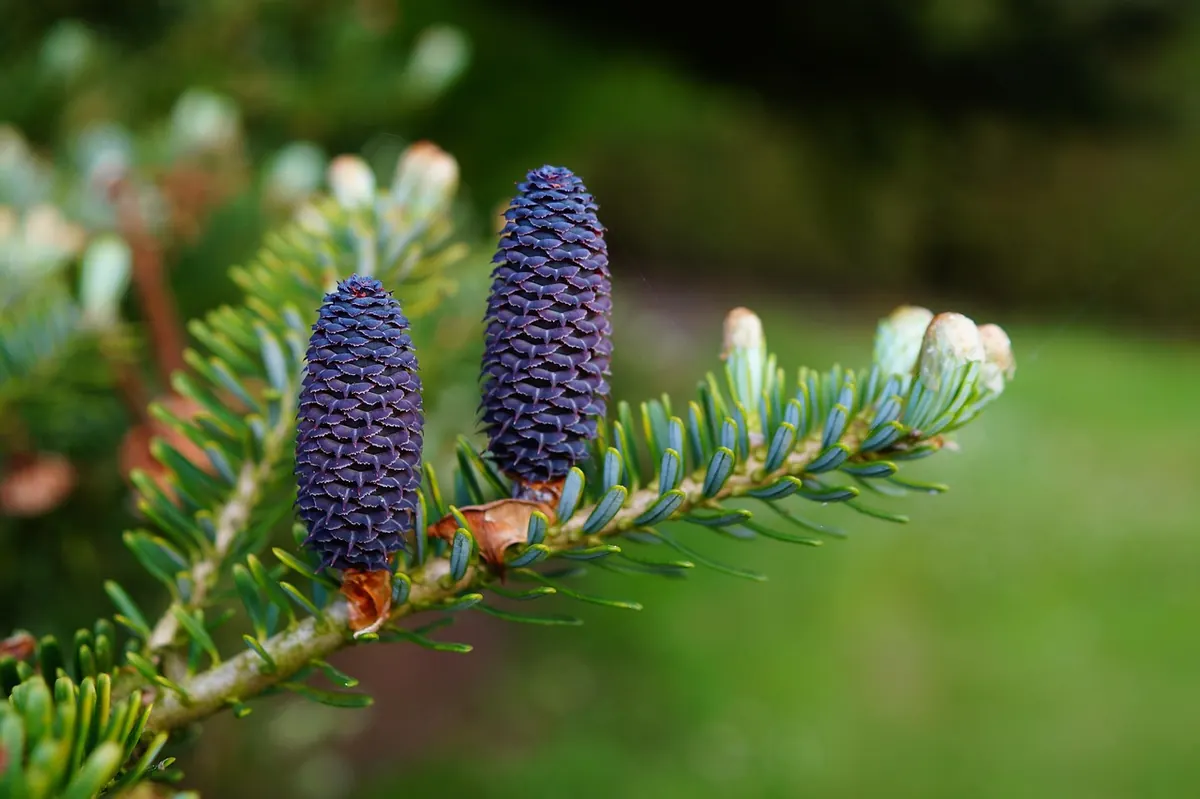
Larch cones are small — usually two to four centimetres — egg-shaped and held upright along the branch rather than hanging beneath it. The scales stay tightly closed, and the cones stay on the tree for years, turning dark grey-brown. Small, upright and persistent is a strong larch signature.
The lookalikes are easier to separate by cone behaviour than by cone shape. Fir cones also stand upright, but they break up on the tree: by winter you find the bare central spike still standing with no scales left. Spruce cones hang downwards and fall whole, often littering the ground beneath the tree. Most pine cones hang too, are noticeably woodier, and take two seasons to ripen, so a pine in summer may carry green young cones and brown older ones on the same branch.
One useful exception: Douglas fir is not a true fir. Its cones hang down and carry three-pronged bracts poking out between the scales, and its crushed needles smell sharply of grapefruit.
Mature larch bark is grey-brown, scaly and fissured into rough plates, often with a reddish tinge in the cracks. Young trees have smoother, paler bark. Bare larch twigs are thin and pinkish-brown, and Japanese larch tends to have redder, smoother shoots than European larch, whose young twigs are a duller yellow-brown and slightly hairy.
Larch is also a tree of the upland fringe: you will often find it planted in blocks on hillsides and in mixed plantations, usually alongside Sitka spruce and Scots pine. That context is a hint, not a proof — always confirm with needles or cones.
Most British larches are one of three. European larch has shorter, lighter green needles and cones with scales that lie flat. Japanese larch has longer, bluer needles and cones whose scale edges curve outwards, giving the cone a slightly opened, rose-like look. Dunkeld larch is a hybrid of the two, first raised in Perthshire, and is widely planted for its vigour. If you are stuck between them, the cones are far more reliable than the needles.
The fastest way to learn larch is to visit one tree four times in a year. Look at it in May, when the new needles are a soft, bright green; in July, when the tufts are full; in October, as the colour turns; and in January, when it is bare and you can see the spur structure clearly. Take one cone home and keep it on a windowsill — a physical reference beats a memory every time.
When you are out, resist the urge to identify from a single feature. Check two or three together: needle arrangement, cone position, and whether the tree is holding its needles at all. And if you are planning to fell, prune or move larch timber, check current guidance from the relevant forestry authority first, as larch is subject to felling and movement restrictions in some parts of the UK because of Phytophthora ramorum. A few minutes of checking saves a great deal of trouble later.
Photo: Kapa65 / Pixabay