Trending

Larch is the odd one out among British conifers: a needle-bearing tree that turns gold every autumn and then drops its needles like a broadleaf. That makes it easy to spot from a distance, and it also makes it a satisfying tree to grow from seed. The cones are small, the seed is simple to handle, and a seedling started in a pot in February can be a knee-high sapling by the following autumn. The only real obstacle between you and a row of young larches is a spell of cold. Get that right and the rest is damp compost, patience and a little shade on hot afternoons.
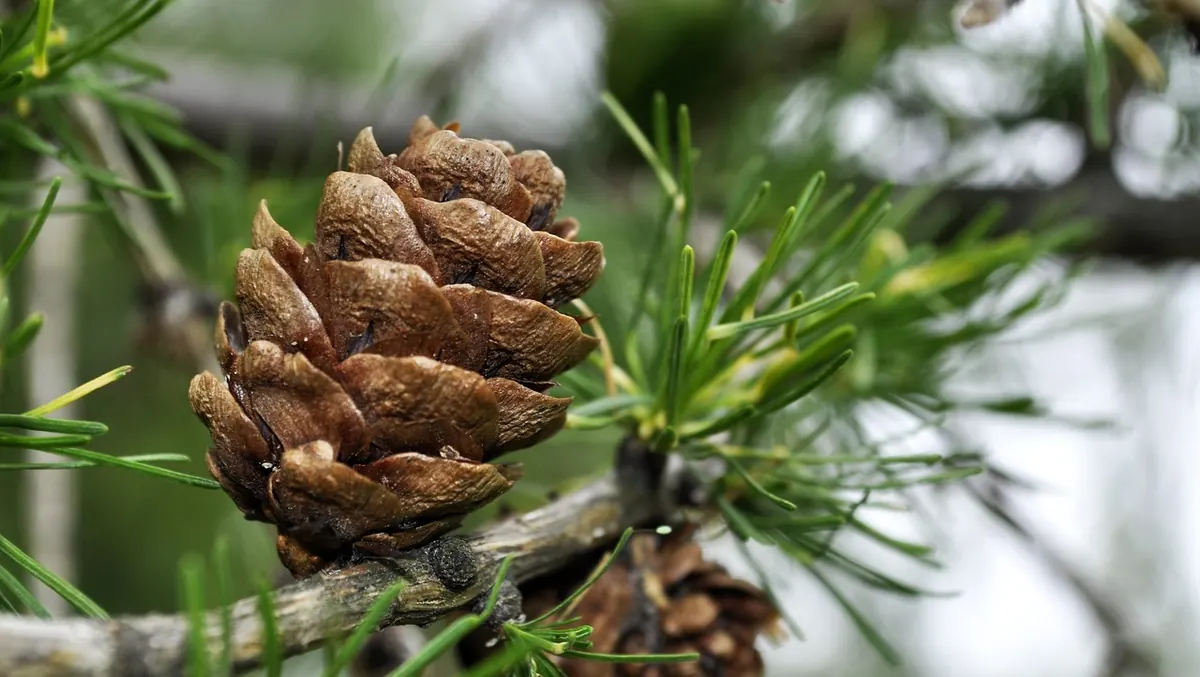
Larch cones ripen through late summer and are ready from roughly September into November, depending on where you are and how the season has run. You are looking for cones that have turned from green or pinkish-red to a soft brown, with scales that have just begun to lift. Once those scales open fully, the winged seed blows away and you are left with empty husks.
European larch (Larix decidua) and Japanese larch (Larix kaempferi) both grow widely in Britain, and the Dunkeld larch (Larix × eurolepis) is a hybrid of the two, often faster and straighter than either parent. Seed from a hybrid will not come true, so expect variation in anything you raise from it. That is half the interest of growing from seed, but it is worth knowing before you plan a uniform shelterbelt.
Spread the cones in a paper bag or shallow tray in a warm, dry room and leave them alone. Within one to three weeks the scales will open and the seed will rattle out. Resist the urge to speed things up with a radiator or an oven; gentle, slow drying gives better results and less mould.
Shake the bag, tip everything into a bowl and pick out the obvious debris. The wings can be rubbed off between your fingers, which makes sowing tidier, or left on — they do no harm. To weed out the empties, drop the seed into a glass of water: most of what sinks is worth sowing, most of what floats is not. It is a rough guide rather than a guarantee, but it saves compost space. Dry the seed again on kitchen paper before storing it in a labelled paper envelope somewhere cool and dry.
Larch seed will not germinate reliably straight from the packet. It carries a dormancy that a cold, moist spell breaks down — the same signal a seed on the ground would get from a British winter. Skip this and you may still get a few seedlings, but they will arrive late, patchily and over many weeks.
If you would rather not use the fridge, sow fresh seed in a prepared outdoor seedbed in autumn and let the weather do the work. It is less controlled, and mice take their share, but it costs nothing.
Sow in late winter or early spring, from about February to April, in a seed tray or small pots filled with seed compost lightened with grit. Larch hates sitting wet, so drainage matters more than richness. Scatter the seed thinly and cover it with only two or three millimetres of fine compost or grit; light helps germination, so do not bury it.
Water from below, or with a fine rose, and cover the tray with a clear lid or a sheet of glass. Keep it at around 15–20°C in a bright spot out of strong midday sun, and ventilate the cover daily to prevent mould. Germination usually begins within two to five weeks, though a few stragglers will keep appearing for another month.
Choose a bed in light shade, fork it over to a fine tilth, sow thinly in shallow drills and cover with grit. Net the bed against birds and check it after heavy rain, when seed can be washed out of position.
Move seedlings on once they have straightened up and produced a few true needles. Lift them with a dibber or a pencil, holding the seedling by a needle rather than the stem, and pot them into deep containers — larch makes a long root quickly, and a shallow pot will set it back. Root trainers or tall tree tubes work far better than a standard tray.
Water regularly through the first summer, feed lightly from midsummer, and harden the pots off outdoors before leaving them out. Expect roughly 15–30 cm of growth in the first season and considerably more in the second. Plant out in the dormant season, any time from November to March, in full sun and free-draining soil. Larch will not thank you for shade or a waterlogged corner of heavy clay.
Collect cones a little earlier than you think you need to, and from more than one tree. Label everything, because a bag of anonymous seed in March is no use to anyone. Check your stratified seed weekly rather than leaving it for two months. And sow more than you want — germination is rarely total, and a few spare seedlings are always welcome as swaps with neighbours.
Larch grows fast enough to feel like progress and forgiving enough for a first attempt. Start with a dozen cones this autumn and you could be choosing a planting spot for your own young trees by the winter after next.
Photo: SurmaCreative / Pixabay